
Eric Topol’s Super Agers Tells Us How To Live Longer & Better
SUPER AGERS. An Evidence-Based Approach to Longevity. Eric Topol. Simon & Schuester.
Ninety-five percent of Americans over sixty have at least one chronic disease and almost as many have two.
Statistics cited by the publisher in jacket introduction.
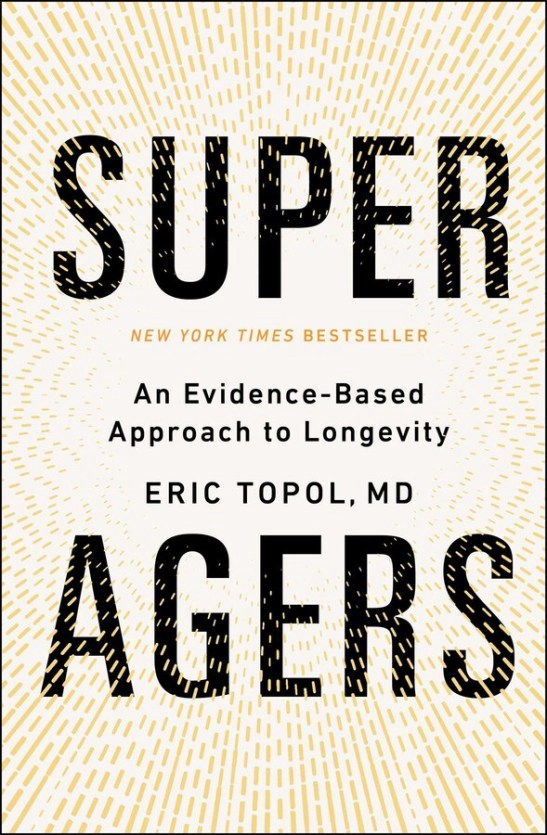
In Eric Topol’s new book, Super Agers, readers are presented with an incisive overview of how the ongoing marriage between science and technology has created an interactive platform increasing the possibility for people to live longer while aging in a healthier overall state. As Topol asserts – the goal here is two-fold: to grow old slowly while avoiding stays in a hospital room along the way.
The idea sounds sublime; but just how do we get there? Topol, a leading cardiologist and professor of molecular medicine at Scripps Research in San Diego, has delivered a practical road map with Super Agers.
In this erudite 4-part study, Topol surveys a great amount of material, beginning his book by analyzing two different patients with two starkly different outcomes – one healthy and one cursed by premature sickness. Previously, medicine’s general position was that genetics primarily set the stage for our aging process, with man sometimes able to temporarily manipulate those factors by employing a quality lifestyle free from fatty foods, alcohol and tobacco.
Topol’s Super Agers certainly addresses this concept, and then takes us a step further – showing us that the ultimate key to the puzzle is in preventing the onset of disease instead of trying to cobble the body together with a a blind array of pills and procedures.
“Until now, our medical approach has been reactive, with secondary prevention at best,” Topol writes in his trademark style that blends accessibility with depth. “A patient has a heart attack; we put them on statins and aspirin to prevent another event. For a diabetic, we treat blood sugar and lower the hemoglobin A1c. While there has been steady improvement in cancer treatments and less reliance on classic chemotherapy, most patients are not getting diagnosed early and the prognosis has extended survival a matter of months for many of the most successful new treatments. We’re in a reactive rut.” (At pages 326-328).
And that, then, brings us to the reason Topol wrote this book – it’s his way of taking the subject by the throat and elevating it to the forefront of science’s collective consciousness. As Super Agers sets forth, the mission is to take what we already know about how man has evolved and then use science as a “means” to effect the resilience of the body. In essence, Topol believes that we need to start paying attention to our health when we’re young, decades before “middle age” strikes – striving to prevent the onset of heart disease and various metabolic syndromes before they manifest themselves into incurable cycles.
In Part IV of his study, Topol cites the COVID vaccine as an example of the way that science was able to do this – intercepting the disease process and lessening the impact of this virulent virus by quickly boosting the body’s immune response. The way that the COVID treatments were developed, with scientists using technology to immediately test and expand hypothesis-es, broke free from outdated research models and showed the world in real time just what’s possible when medicine renews its commitment to vision and takes some new risks.
Like I said earlier, the idea certainly sounds sublime, but Topol is also a realist and he issues a stern warning, noting that these great advancements can’t ever happen unless there is a seismic shift with regard to the way we govern ourselves.
“Before my optimism gets too far out front, let me reiterate the two factors that remain the most formidable obstacles,” Topol writes. “One is the profound health inequality. This has positioned people who are underrepresented or with low socioeconomic status at highest risk, not only for their lifestyle+ factors such as poor nutrition air pollution, but also for their access to all the innovations discussed in this book. The second great obstacle is about chasing our own tails…little or nothing has been done to address pervasive and worsening air pollution, micro and nanoplastics, the toxic PFAS forever chemicals [and the] intake of ultra-processed foods…[while] the unabated mis- and disinformation anti-science movement, centered around conspiracy theories spreading in social media and digital media of all kinds, threatens the acceptance and use of momentous discoveries…” (At pages 329-330).
Eric Topol’s Super Agers arrives with a message on practical ways to extend longevity and thus lessen the healthcare burden on government and society. The map has been published. But will we have the collective resolve to take those first critical steps forward?
Follow Dr. Topol’s work on Ground Truths.
 Electric Review