
Blood In the Tracks Finally Recognizes the Six Musicians Behind Bob Dylan’s Classic
BLOOD IN THE TRACKS. The Minnesota Musicians Behind Dylan’s Masterpiece. Paul Metsa and Rick Shefchik. University of Minnesota Press.
Dylan had been searching for a way to start writing songs “unconsciously” again – a way he had in the mid-1960s. “Right through the time of Blonde On Blonde I was doing it unconsciously,” he told Cott. “Then one day I was half-stepping, and the lights went out. And since that time, I more or less had amnesia.”
(page 7)
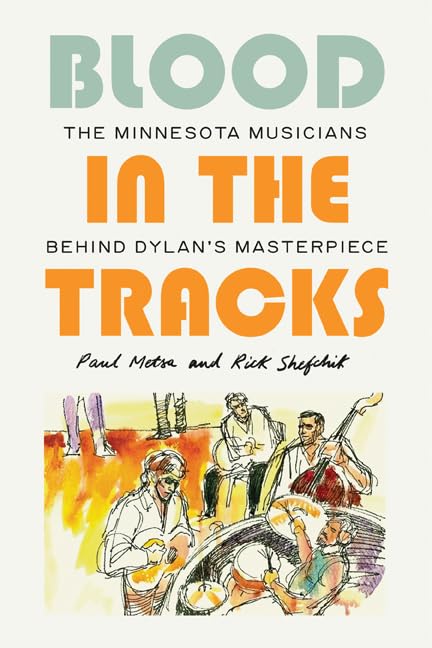
Bob Dylan’s Blood On the Tracks is widely regarded as one of Rock’s greatest albums, telling the story of the collapse of the musician’s first marriage via ten of his most personal poems. While most people gravitate towards the singing and writing on Tracks, the musicianship is no less stunning – with the story behind how Dylan came upon the final sound for his record also an instant classic.
Blood On the Tracks was originally cut in New York in 1974. But after finishing in the studio, Dylan became disenchanted with the sparseness of the record. After discussing the scope of the project with his Producer/brother, David Zimmerman, he decided to return to his home state of Minnesota in December to re-vamp five tracks, including the seminal pieces “Idiot Wind” and “Tangled Up in Blue.” These five songs were eventually recast at Sound 80 over two nights, with six local cats from Minnesota backing the poet at the microphone.
“David Zimmerman shared his brother’s concerns about Blood On the Tracks when he heard the acetate of the forthcoming album in December 1974. Although he has never publicly spoken about his reaction to hearing the New York sessions for the first time, he no doubt had similar suspicions that there wasn’t a hit on the album,” the authors write. “The critics might like the album – in fact they might fawn over it as the comeback they’d been waiting for – but it was very unlikely to get much radio play or sell in significant numbers. Ten acoustic songs in open D tuning? That was no formula for a pop smash.” (page 21).
Even though David Zimmerman has taken a ton of criticism for recommending Dylan re-record portions of Blood, I think time has proven him correct. Back in the early 1970s, Dylan was struggling to find a new audience, and had he released the original record it probably would not have been the hit it became – like Zimmerman surmised, that sparse acoustic sound just wasn’t right for radio circa 1975. In turn, the revised “Tangled Up in Blue” benefited from the bright sheen the band gave it as the song climbed to #31 on the FM radio play-lists.
The ensemble Dylan hired proved to be a perfect fit for the songs and Blood quickly became Dylan’s ‘album of the 70s.’ Only thing is, the six musicians who collectively propelled the record forward: twenty-one-year-old mandolin player Peter Ostroushko; drummer Bill Berg; bass player Billy Peterson; keyboardist Gregg Inhofer; and guitarists Chris Weber and Kevin Odegard, were never credited.
And that’s really why this book was written: Blood in the Tracks, just released by the University of Minnesota Press, finally throws some light on the faces of the six studio musicians who bring body and soul to Dylan’s songs of lost love and restlessness. As such, authors Paul Metsa and Rick Shefchik go back to the beginning to revive the story, showing all the twists and turns in the road that brought a half dozen random guys into a room with the greatest force in the history of recorded music.
But Metsa and Shefchik don’t stop there. Instead, they’re brave enough to take Blood In the Tracks a step further, showing readers what reality is like for most professional musicians, showing us in real time how most toil in sad obscurity while working dead-end jobs to support their ‘calling.’
Blood On the Tracks is probably the greatest, most fully-realized record that has ever been made. Meanwhile, Blood In the Tracks – the story of how the album was laid on tape – is no less riveting, as we come to forge an intimate relationship with six random dudes from Minnesota who battled for forty years to have their work recognized alongside the poet-minstrel who’d hired them.
Also by Paul Metsa
Blue Guitar Highway. Paul Metsa. Foreword by David Carr. University of Minnesota Press.
This book, written by Minnesota musician and author Paul Metsa, is the real deal, telling the story of what it’s really like to play professionally. Over the years, Metsa has straddled the stage with Billy Bragg, Pete Seeger, and Bruce Springsteen. He’s also endured times when he didn’t know if there would be a next gig. Every kid contemplating a tour through this business should read Blue Guitar Highway. It’s a reality check they can’t afford to miss. Forward by veteran journalist David Carr.
Of Related Interest
BOB DYLAN IN MINNESOTA: TROUBADOUR TALES FROM DULUTH, HIBBING & DINKYTOWN. K G Miles. With contributors: Paul Metsa; Ed Newman; Marc Percansky and Matt Steichen. McNidder & Grace.
A chronicle the effect Dylan’s home state had on his creative psyche. See John Aiello’s review here.
by John Aiello
One comment on “Blood In the Tracks Finally Recognizes the Six Musicians Behind Bob Dylan’s Classic”
Talk to Rat:

 Electric Review
Hi Rat:
How’s it where you are?